


What’s your fantasy of how things get better in Minneapolis?
Maybe you imagine ICE pulls out for good, stops arresting people who have been part of your community for years, and peace returns.
Maybe you imagine the protesters retreat, let ICE quietly do their lawful job, and peace returns.
Neither of these are going to happen. The situation is too hardened, too bound up in decades of culture war, bad policy, and media narrative.
And now people are getting hurt.
This post is my attempt to map what actually can happen, to find a way through for all of us. First I’m going to argue that violence is not a winning strategy for either side. This leaves only political solutions, and I can think of two: border enforcement plus either a path to legalization or state-level selective enforcement. The next question is, if these solutions are possible, how do we get there? I’ll analyze the conflict in a little more detail to try to find possible paths. I believe that citizen non-violent power is essential, but the objective has to be getting the other side to negotiate.
Violence will not win
We have to get this out of the way first. Violence is not just a moral disaster but actually strategically ineffective here. Limited violence won’t deter either side. In fact it’s most likely to the advantage of the victims, if it’s documented and disseminated. Both the “direct action” folks and the “SWAT team” folks are wrong, I’m sorry. And escalating violence won’t work either.
Preventing ICE operations by physical force is not an option for the protestors. Non-violent protestors are surrounding ICE agents, sometimes causing them to abandon arrests, which has plausibly slowed their operations. But ICE is changing tactics as well, going out in smaller groups and making arrests more quickly. Stopping the arrests entirely would seem to require far more physical force. And regular citizens are not going to win this one. Even though the Supreme Court has ruled that Trump cannot deploy the Minnesota National Guard against the Governor’s wishes, he has threatened to use the Insurrection Act to deploy the military.
On the other side, using mass force against civilians is an extremely bad look and a worse idea. It’s banana republic stuff; this is what Iran is doing right now (and Trump is on the protestors’ side there). Mass violence is very likely to radicalize further protestors — this is a classic dictum of counterinsurgency warfare, supported by evidence:
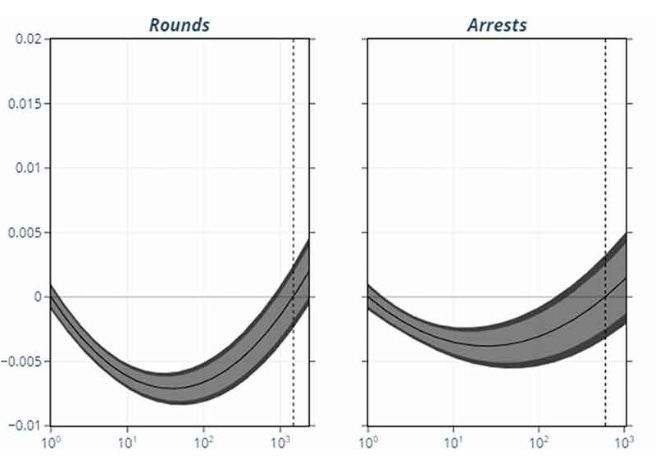
Even authoritarian leaders need citizen support, historically speaking. This is especially true if they have elections coming up, and indeed the White House is currently worried about the optics of ICE.
Two political solutions
If neither limited nor escalating violence will win, then a political compromise seems to be the only solution. I have come across two ideas I find plausible. One is already popular, the other is a radical change.
The popular solution is strong border enforcement combined with a path to legality for people already here. We have the former now (and didn’t under Biden), while we’ve never really had a full path to citizenship or normalization for all unauthorized migrants. This solution is popular, as we’ve said before. Here’s Pew’s data:

There’s a lot more polling confirming this point:
Legal status for undocumented immigrants is decidedly more popular than mass deportation. Americans consistently prefer a path to legal status instead of mass deportation – and are measurably swinging in favor of legal status in recent months.
Strength In Numbers/Verasight national poll (August 2025): By a 60-40% margin …
Fox News (July 2025): … a 59-29% margin. …
Navigator national polling (conducted by GSG/GBAO, July 2025): By a 63-27% margin …
Gallup (July 2025): 78% of Americans support citizenship for undocumented immigrants …
Quinnipiac University (June 2025): By a 64-31% margin …
Pew Research (June 2025): By a 65-34% margin …
There are currently several bills in Congress that would implement this sort of solution.
Another potential political settlement was suggested by one of my favorite smart but unorthodox friends. It is this: have strong national border enforcement, but let individual states choose whether they want to deport unauthorized immigrants or let them live freely in American communities. This would effectively formalize the “sanctuary state” equilibrium that held for quite a long time. Of course, it would also be unsatisfying to almost everyone. This is one of the many examples where local and universal values conflict (see: Should Abortion Laws be the Same Everywhere?). It may seem far-fetched but similar policies have been proposed before, such as the Heartland Visa which would allow states to set their own (legal) immigration levels.
Perhaps you can think of other innovative policy compromises. Once victory by coercion is off the table, there’s a huge space for fresh ideas.
Who are the sides?
If political solutions are possible, then the question becomes how to get there. This is what I’ve been trying to think through this week. As a first, step, I wanted to define the “sides.”
Who is fighting whom here? One could say it’s Minneapolis protestors vs. ICE, but at root this issue is national, not local. I’ve also heard that this is really about left vs. right, or perhaps government vs. citizens, or maybe even order vs. anarchy. I’m not so sure. Instead, I think the current conflict is best conceived as something like:
“The Administration and Red Americans”
versus “Blue Americans”
with “Independents” caught in the middle
I organize the coalitions this way because Republican voters still overwhelmingly support the deportations, ICE, and Trump, and say the shooting of Good was justified.

This breakdown is relevant because it suggests that the Administration can only sustain power over Blue Americans if Red Americans support its actions. As I noted above, governments do not last without the support of their citizens, and there are elections coming up.
Bringing the adversary to the table
Right now, neither side wants to talk about a compromise. Vance came to Minneapolis for a “round table” but did not talk with Gov. Walz. It’s hard to speak for “Blue Americans” in general but my previous plea for policy reform has been called “naïve.” It certainly doesn’t have the strident provocation of “ICE out of Minneapolis now!”
Mediation between the sides may be possible. I don’t know if anyone is trying. More likely, if a political settlement is reached it will be because one side has enough power that negotiation begins to look like the better option. (Otherwise we can only hope for a hurting stalemate, which is grim indeed.)
The Administration could put its efforts into a political solution. After all, with the current Republican majority Trump more or less gets what he wants from Congress. But I imagine the Administration is very unlikely to unilaterally open negotiations. If I’m right about this, this leaves open only actions on the citizen side.
Here’s how that could go down. Take a look at the power strategy mix we covered previously:
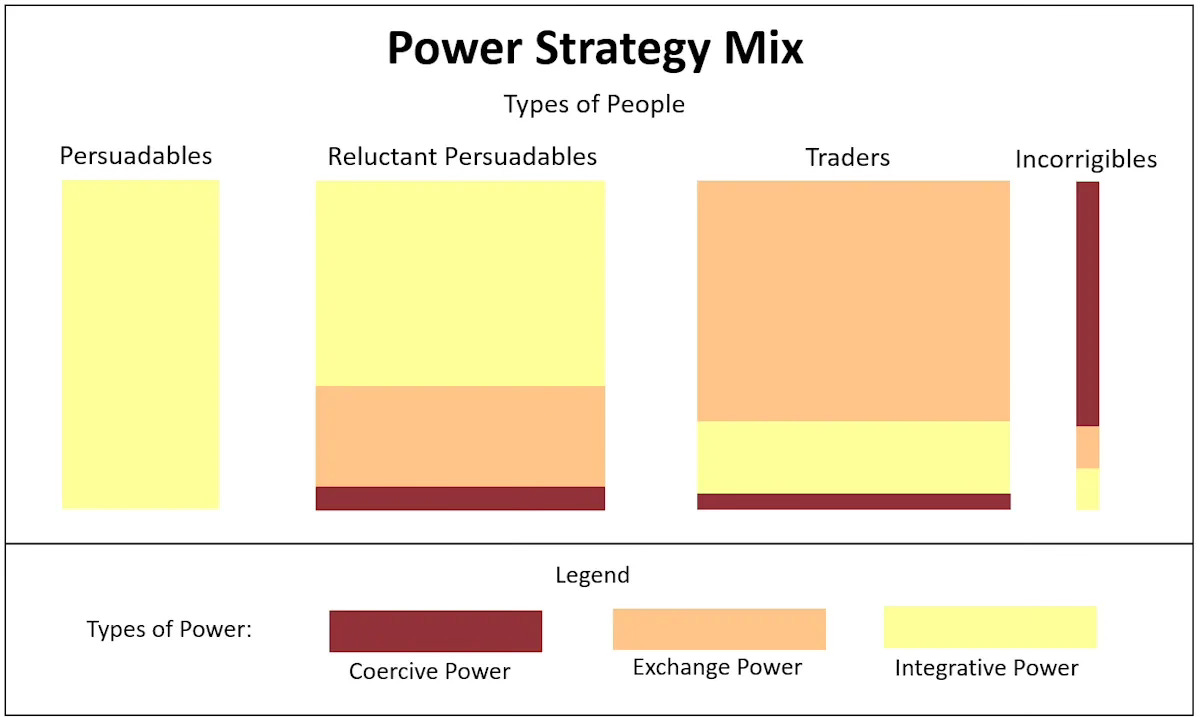
With regard to heavy-handed ICE enforcement, I consider the Administration in the “incorrigible” category, meaning they will not change their mind if they aren’t forced. But coercive force is hard for regular people to generate.
However, self-identified Independent voters are “persuadable,” and are in fact being persuaded. Support for ICE and for deportations is falling among independents.
Further, only about 40% of self-identified Republicans call themselves “MAGA”. I would guess the non-MAGA majority are mostly in the “reluctant persuadable” or “trader” category (because people are generally much less extreme than we perceive them to be). And persuasion is something that regular people can do. The loss of public support is ultimately the Administration’s biggest weak spot.
This strategy is also consistent with a general analysis of the way we avoid an authoritarian future for the country (from either right or left): we need to shift the axis of polarization from “left vs. right” to “freedom vs. authoritarianism.”
Anti-ICE doesn’t mean pro-immigration
Support for ICE and deportations is falling among Americans. That doesn’t at all mean that people agree with the Democrats on immigration policy. Last week’s Wall Street Journal poll found that
Americans believe the GOP is the better-equipped party to handle border security by a whopping 28-point margin — 48% to 20%. Republicans had an 11-point advantage on immigration as well
Rather, the shift in attitudes is being driven by a sense that the Federal government is overreaching. This is the frame that is changing people’s minds. Analyst Mike Madrid summarizes the situation, with advice for the anti-ICE side:
Americans still tell pollsters they support “strict immigration enforcement” or “deporting people who entered illegally.” Those abstractions sound reasonable.
But show them what enforcement actually means: National Guard troops occupying Los Angeles, agents in tactical gear raiding Sunday services, children screaming as parents are dragged away, neighbors who’ve lived here fifteen years vanished overnight, Renee Good killed in Minneapolis — and they reject it completely.
The gap between theoretical support and tolerance for actual implementation is the entire story.
NOTE: Focus messaging on violent overreach and the chaos - do not bring the message back to the message frame on immigration reform because that is NOT how this is viewed by the public. Refuse to step on a winning message.
The right framing is especially important for independents. While “abolish ICE” has the highest support it’s ever had, it’s still terrible messaging. Better performing frames are much more reasonable:
Highlights from Blue Rose Research’s new poll-tested messaging memo:
Messages tend to be less persuasive when they use charged language or sweeping calls like “abolish ICE” or “state-sponsored terrorism.” More measured language that focuses on accountability and common-sense tends to be more effective at hitting Trump or increasing perceptions of Democrats.
Initial research from video testing reinforces these findings in a real-world media context: In testing of 15 viral viewed videos about the Minneapolis shooting, raw eyewitness footage and straightforward reporting consistently drove meaningful increases in Trump disapproval, while ideological or maximalist rhetoric from elected officials often underperformed or backlashed.
Writing a better ending
Somehow, the story of the Minneapolis conflict has to end. Everyone has been so focussed on the terrible things happening now that we haven’t really thought through where this all goes. If this historical episode ends well, what would that look like? Who would have to do what to make that a reality? We have to figure that out, because every other path leads to heartbreak.
Quote of the Week
That’s an ad hominem. You can’t just attack me for being a bad person. You have to contend with my argument. And you have to love me
I'm glad I found your substack! If only Americans could rely on an independent panel of conflict negotiators approved by Congress but NOT entrenched in our polarized politics. Maybe there is a highly respected foundation without a 501c4 that can fashion a cease-fire and mutual withdrawal from this or that US war zone. Politicians would pull back from their rhetorical warfare and convene to consider the panel's findings and recommended long-term solutions.
Excellent analysis with out-of-the-box ideas Dems should definitely consider.