

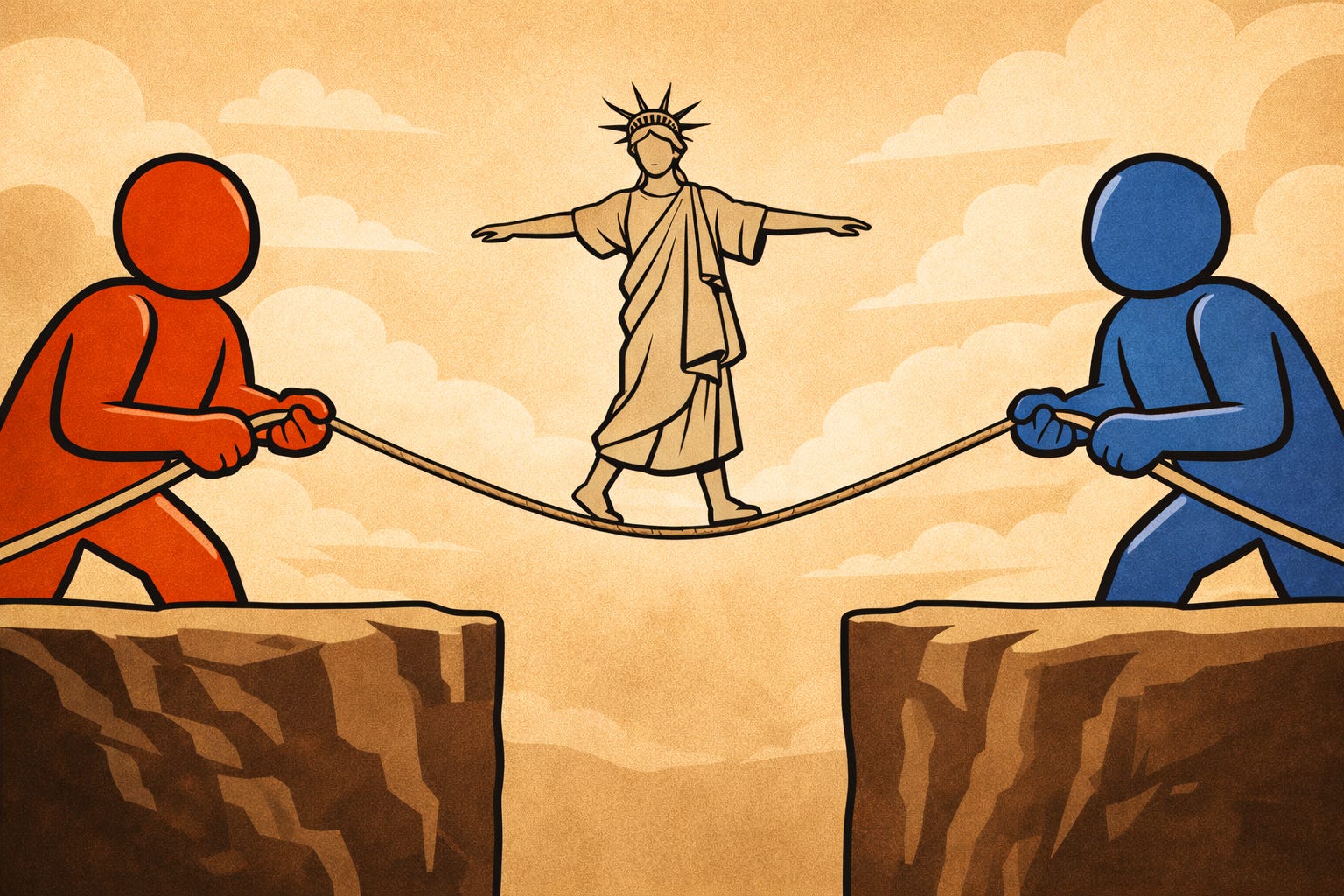
Because of the circumstances of Renee Nicole Good’s death, this personal tragedy is also a national crisis. Unfortunately, it is likely to be even more escalatory than Charlie Kirk’s murder.
The question I find most urgent right now is: what politically plausible structural changes could reduce the likelihood of further violence?
I spent most of yesterday talking to people on both the left and right about where we go from here. I am not telling anyone not to stand up for what they believe in. I am not judging who is right or wrong — even though that is what most people desperately want to talk about right now. Instead, I am trying to figure out a broadly agreeable path, something that both Red and Blue Americans can get behind, that might reduce future bloodshed.
This is a really hard problem, but I think a few key pieces of the puzzle are reasonably clear.
We are not going to agree on what happened
This incident is really, really bad not just because someone is dead, but because there will be no agreement on what actually happened even for people who watch the same video. This is why the situation is so volatile, much more so than Kirk’s murder where it was at least clear who did what.
The Blue story is that she was trying to drive away from ICE officers who were running toward her car. The Red story is that she was trying to drive into the ICE officer who shot her, or at least interfering with a legal law enforcement operation. This is the view of the Trump administration, but perhaps more importantly it is the view of a wide array of right-leaning influencers and citizens.
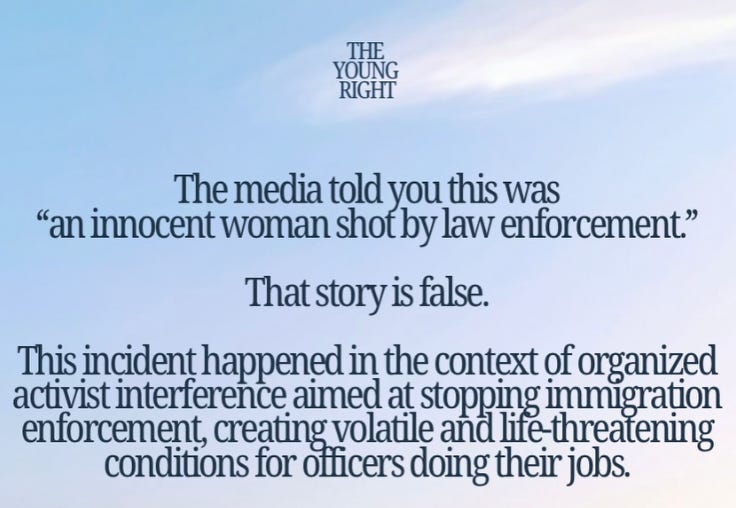
If you want an account of who believes what and why, see Tangle. If you want a slow motion breakdown of the various videos with minimal editorialization, see the New York Times. But for conflict analysis purposes, the thing to understand is that this is a textbook-perfect “scissor,” a situation where each side believes the evidence is so clear that they cannot comprehend how someone else could see differently.
I am quite sure most of my readers will think this is insane. Surely the video makes the facts plain to all. What I am telling you is that, empirically, it does not.
Why do I care about this? Because it informs strategy. I don’t see any way that discussion about either the facts or the morality of the situation will be productive in the near term. Having had several of these conversations in the last few days I can confidently say that arguing about who is morally right is currently a dead end.
But there are other propositions that seem to be widely agreeable.
Government can provide assurances of accountability
Whether the officer is at fault will eventually be decided in a court, where all the evidence can be presented. Maybe. That’s the problem.
Unfortunately, the message coming from the White House is not reassuring. V.P. Vance has said the officer is afforded “absolute immunity” (which legal experts dispute). Meanwhile, the FBI has frozen state and local law enforcement out of the investigation and is no longer sharing evidence or information. This is not normal procedure.
If too many people believe that ICE can act with impunity, then this police force will lose all public legitimacy. Citizens would then be morally justified in rebelling against an unaccountable armed force. It is vital for all levels of government to reassure the public that Good’s killer will be impartially investigated and held to the standards we expect of police who are paid to protect us.
ICE agents can be better trained
ICE agents are being rapidly recruited and many have only minimal law enforcement experience. Typical training has been shortened from six months to six weeks, and DHS is not answering questions about how they have changed their recruiting standards (including skipping background checks). This matters because there is ample evidence that officers who have not received proper training in de-escalation, or even just less experienced officers, use force more often.
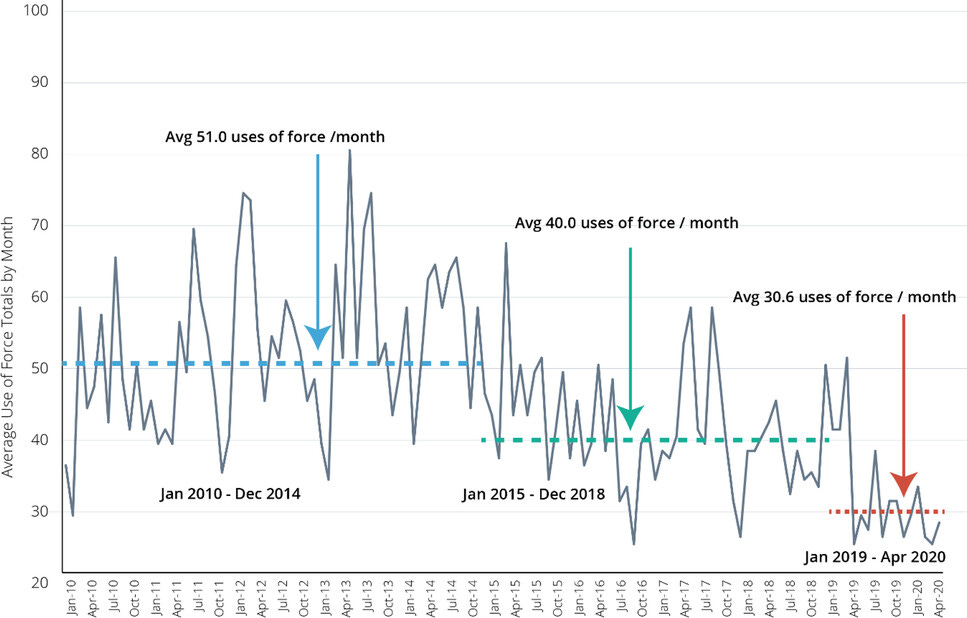
Experience per se was not the problem here. The officer who shot Ms. Good has been with ICE since 2015. But unfortunately, we should expect further incidents if nothing changes. The rapid expansion of ICE has resulted in dangerously insufficient training for armed officers who regularly encounter charged situations.
Protestors can change tactics
What ICE is doing is largely lawful. If citizens disagree with the law, they can undertake civil disobedience. This is a deeply American tradition — it has been used to defend everything from freedom of religion to equal rights. I don’t think it’s reasonable to deny people’s moral right to knowingly break the law, if they are willing to bear the consequences.
But this does not address the issue of safety. Ms. Good seems to have been involved in anti-ICE protests, including attending specific training. Clearly it wasn’t enough. This may sound like victim blaming, but the issue isn’t moral but pragmatic. It’s therefore good to see that protest organizers are doubling down on the message of de-escalation and non-violence. In fact, most organizers are specifically arguing against civil disobedience:
A core principle behind all ICE Out For Good events is a commitment to nonviolent action and no civil disobedience. We expect all participants to seek to de-escalate any potential confrontation with those who disagree with our values, and to act lawfully at these events. Weapons of any kind, including those legally permitted, should not be brought to events. All events should be held in public spaces or on public property.
…
If you choose to host your event at or near a law enforcement facility or any other government building, please take extra caution. Do not block entrances, exits, or pathways of government buildings. Do not engage or confront any law enforcement personnel including federal, state, and local agencies. If possible, refrain from holding events at or near government or law enforcement buildings/areas. Prior to your event, please become familiar with all local, state, and federal regulations around gatherings of this type and follow them closely.
But this doesn’t come without practice and discipline. De-escalation training has long been a key part of civil resistance training, and protestors need such training now more than ever. Princeton's Bridging Divides Initiative maintains a state-by-state directory of 100+ de-escalation, bystander intervention, and community safety trainers. They also publish de-escalation guides for specific contexts (poll workers, elected officials, bystanders).
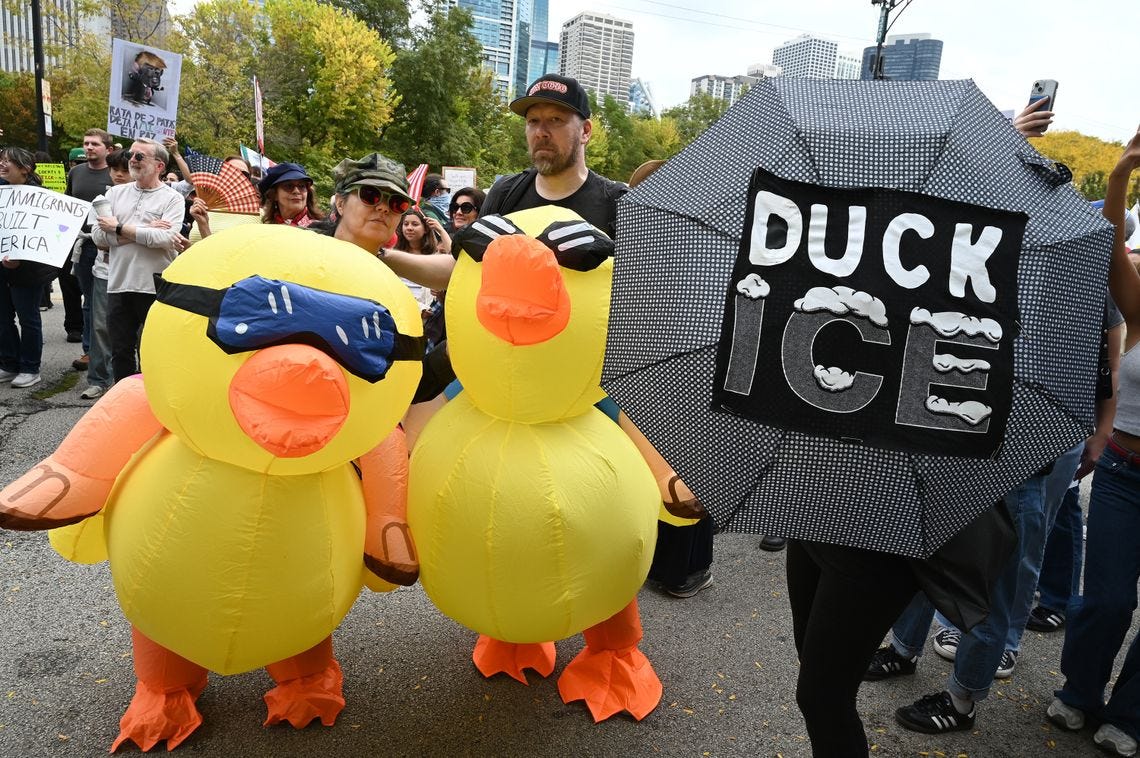
More fundamentally, protest tactics do not need to be aggressive. Humor and mockery can be very effective, especially in today’s media ecosystem. We’ve previously analyzed The Strategic Logic of the Naked Bicycle Ride. There are even training programs on “serious play.”
The path forward is to fix immigration policy
For any of this matter, we need to address larger issue of rationalizing immigration policy.
As we have discussed previously, there is a compromise that almost everyone will accept: strong border security and immigration enforcement combined with a path for unauthorized migrants already here to stay legally. Both are required: what we have now is strong border control without a good answer for those already here, while if there is a path to citizenship without strong border control then it’s an open invitation for the rest of the wold to come here. This combination is in fact a popular position.
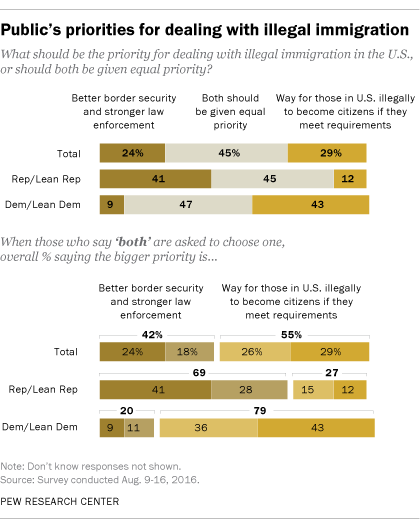
In a hopeful sign, there is a bill in Congress that would do exactly this:
Rep. Maria Elvira Salazar (R-Florida) introduced the Dignity Act of 2025 (H.R. 4393) in the U.S. House of Representatives on July 15, 2025, a bipartisan effort to strengthen border security in the United States, provide undocumented individuals with an opportunity to obtain legal status if they meet certain requirements, and update aspects of the U.S. legal immigration system. The bill is co-sponsored by Rep. Veronica Escobar (D-Texas), and an additional 10 original Republican co-sponsors. It is a revised version of the Dignity Act of 2023.
The big picture
In the wake of tragedy, there is a rush to blame. But what happened this week in Minneapolis is about far more than the handful of people who were there. This terrible outcome is the result of larger structural forces; it was both predictable and predicted.
Despite all of the attention that this latest atrocity has received, if our goal is to prevent further loss of life, focussing on this individual incident won’t help. Americans will probably never agree on what happened. But my experiences over the last two days, talking to people about it, has convinced me that we can agree on where to go from here.
Quote of the Week
Billy Joel could do a whole new We Didn’t Start the Fire just about the last week
Minor quibble about the efficacy of mockery but this is a very sober, thoughtful and helpful analysis. Thank you.
Yes, point the way forward, instead of looking back. Find the gifts: what did this incident teach us, what did we get a chance to practice through this, what did it inspire us to do?