

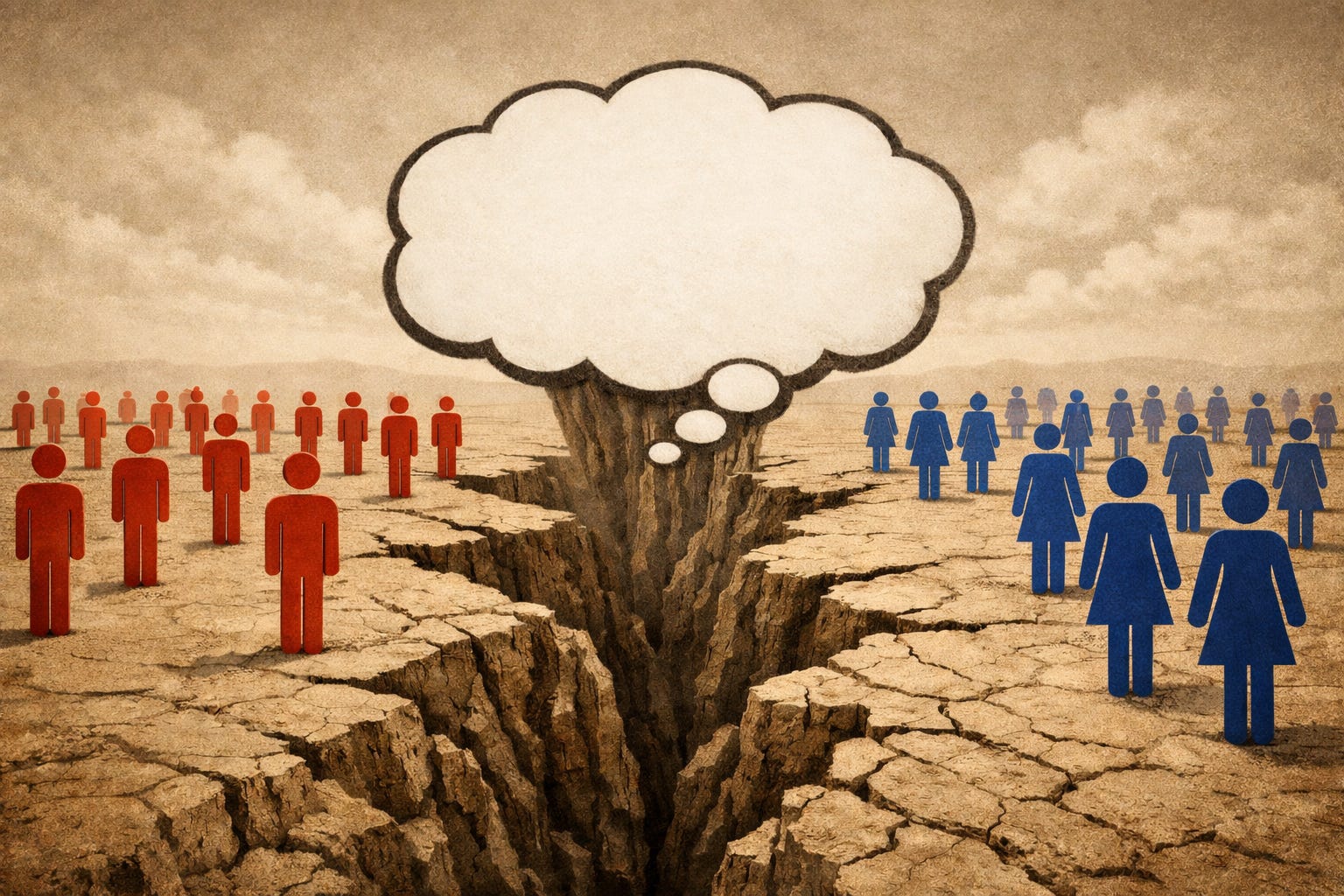
The ascendance of Trump and other populists around the globe has spawned many narratives to explain why, including this one: men are sick of feminism so they vote for authoritarians to restore their lost status. Seva Gunitsky’s The Incels Are Taking Over is the most recent attempt (after many previous articles) to unify the manosphere and the strongman into a single phenomenon.
Two questions are worth asking about a claim like this. The obvious one is is it true? The less obvious one is what are the effects of believing it’s true? During the same period that this became a popular narrative, American gender relations fell to an an all time low. Could bad narratives be part of the reason that it’s harder than ever for men and women to find love?
The central argument, as Gunitsky puts it, is,
The emergence of far-right personalist rule is not just a symptom but a direct result of the crisis of gender politics: the collision between global gains in women’s status since the 1960s, and the psychological and material displacement of men who had organized their identities around traditional gender hierarchies.
…
gender grievance is not a superficial aesthetic layered on top of right-wing populism but one of its key drivers
We all know the stereotype: resentful young man says he voted for Trump because feminism went too far. Gunitsky is a serious conflict scholar who points to the gender gap in votes for Trump, Bolsonaro, Duterte, Orbán, and Erdoğan, and all his numbers are correct — the correlation is real, and in the right direction.
But this story is a causal story, and there’s a cost to being wrong about it.
Does sexism change votes?
First of all we need to be precise about how we’re measuring male grievance. When people talk about the politics of “incels” it’s usually rhetorical rather than literal, meant to evoke a certain contemptible stereotype (which is not really accurate anyway, as incels lean slighly left). But let’s switch to a standardized way of measuring this, the “hostile sexism scale,” a survey with four questions asking whether women a) complain about discrimination when they lose in a fair competition, b) seek special favors under the guise of equality, c) fail to appreciate fully what men do for them, and d) are too easily offended, each on a 5 point scale.
I pulled the 2024 American National Election Survey (ANES) data to plot the correlation between voting for Trump in 2024 and scoring above and below median on the “hostile sexism” questions.
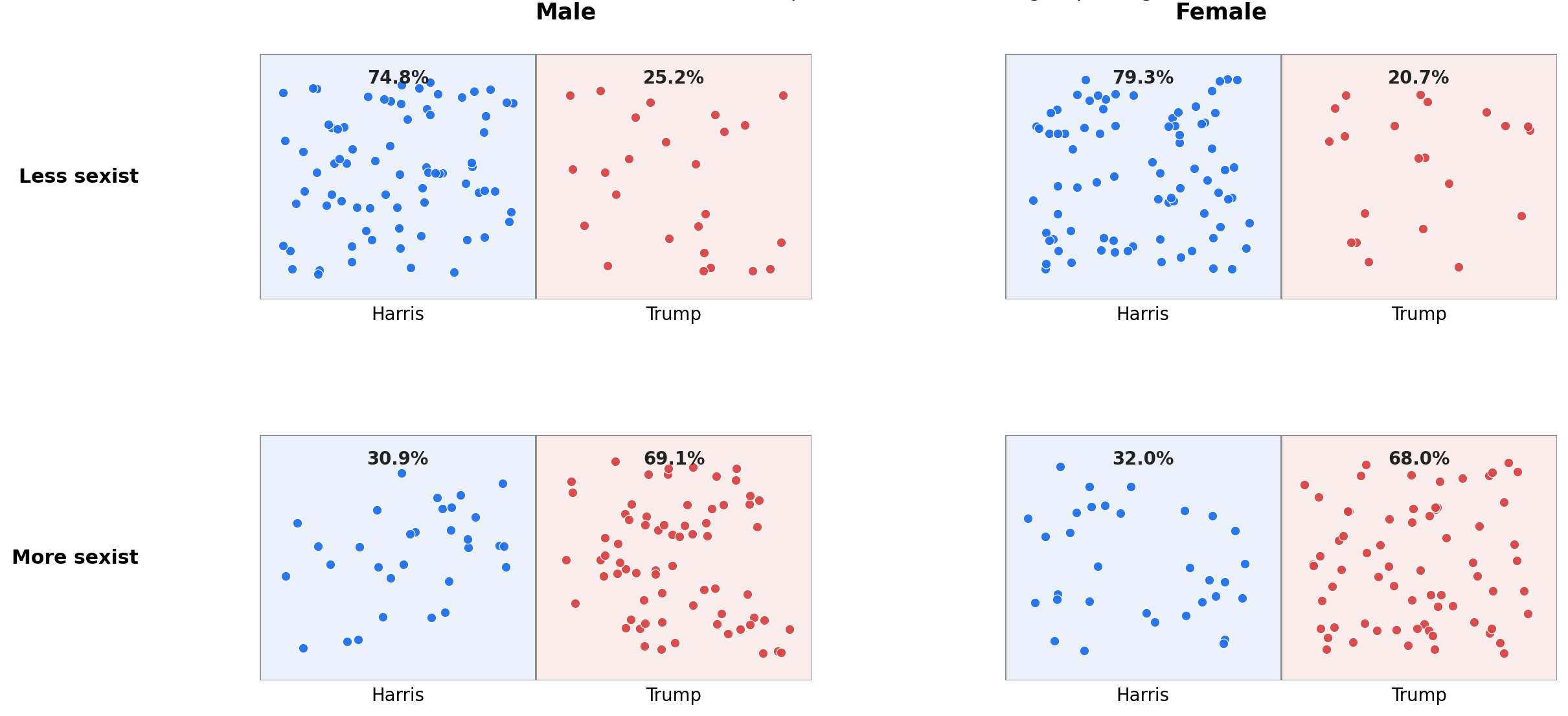
Less sexist people definitely voted for Harris more, while more sexist people definitely went more for Trump. Interestingly, there is little difference between these patterns for men vs. women.
So does this mean “hostile sexism” is why people vote for Trump, or for right wing populists in general? Here’s the problem with that theory: you can replace “sexism” with “education” and see a similarly strong correlation. Or you can look at the number of immigrants in each county and the vote share, also a clear correlation. Etc. So which is it? What’s the driving factor?
Two recent studies test this hypothesis more carefully. First, Abrams and colleagues surveyed Gen-Z voters across 24 European countries. Among those 20-25, men vote right more often (37% vs. 24%). “Sexist attitudes” were measured by agreement with similar survey items as above, but these attitudes only accounted statistically for 10–13% of the voting gap. This limits the size of any potential effect. In other words, everything other than sexism accounts for 87% of the left/right difference in male/female voting in Europe.
Another recent paper tests causation directly. In 2013, an experiment with 111 undergraduates showed that “inducing masculinity threat increases support for war, homophobic attitudes, and endorsement of dominance hierarchies.” This has been the lab-science link for the masculinity-causes-populism narrative for the last decade. This new work is a 2,774 person replication on a nationally representative sample. And it doesn’t hold up in this higher-powered study. They could not replicate the effect, writing “we observe no consistent evidence that masculinity threat alters political attitudes.”
The cultural connection between male resentment and right wing populism holds up. As Gunitsky notes, all of the influencers in the recent Inside the Manosphere documentary voted for Trump, and all of the recent right wing strongmen are hyper-masculine. But neither influencers nor politicians are representative of regular people, and the evidence that men vote for right wing populists because of gendered resentment is thin.
Bad narratives shape bad perceptions
The male/female gap in politics is real, and men do tend to vote more to the right. However, the best available evidence suggests they (mostly) don’t do this because they’re sexist. The story that they do may be unhealthy for a number of reasons aside from the fact that it’s not true.
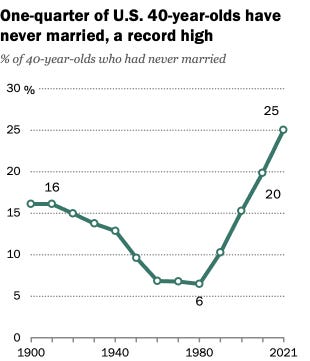
Narratives matter. Teaching young women about gender stereotypes makes them less likely to enroll in STEM courses. And bad narratives may similarly explain some of the mental health gap between liberal and conservatives. Similarly, it seems bad for society to strengthen politically charged gender stereotypes. Love in the time of polarization is already fraught, and America has falling levels of dating, marriage, and sex among the young.
Conflict narratives don’t just describe a fight, they are part of what creates the sides. The causal coupling of male grievance to far-right politics is a polarizing story. It tells feminists and anti-populist liberals that their antagonists are the same — and such coalition-building is probably the intended effect of repeating the idea.
However, it’s too easy to confuse “sexism is higher among Trump voters” (true) with “men vote for Trump because they are sexist” (doubtful). Going further to “all Trump-voting men are sexist” is a logical fallacy, but it’s intuitively plausible because it matches stereotypes. Likewise, this narrative tells young men who are uncertain about their politics that their irritation with modern gender norms already puts them in a camp.
Meanwhile America is in a romantic recession. The recent essay Pride and Polarization is a nice discussion of the demographic realities of politics and love, noting that 70% of Democrats now say they wouldn’t date a Republican.
The result, as National Marriage Project director Brad Wilcox has pointed out, is that there are now two liberal women for every one liberal man, and two conservative men for every one conservative woman. With young Democrats more than twice as likely to say they won’t date a Republican as the reverse, the problem is especially acute for conservative men—and, conversely, for liberal women. The intense tribalism shuts out millions of couples who might otherwise be compatible
…
People with different political views can be compatible at the individual level. Most people’s direct political involvement, no matter how heated they get in conversation, consists only of casting a vote roughly once a year, or even once every four years. There is much more to life, and any couple will need to struggle through conflicts much more concrete and consequential.
There is a connection between male resentment and right wing populism — anyone can see that in populist leaders and manosphere influencers. But among regular voters it’s hardly universal and it doesn’t seem to be causal. We have to be more careful with the demographic and causal specifics, if we want to avoid stereotyped perceptions and unhealthy narratives.
The second study fails to replicate an earlier finding experimentally, with a larger, more representative sample. That means what was taken as evidence for a causal relationship is now suspect. However, inducing masculinity threat then checking whether support for war, homophobic attitudes, and endorsement of dominance hierarchies increase is hardly the only way one might try to measure a causal relationship between male resentment and right wing populism. It could be that circa 2013 there was a causal relationship, which is responsible for the continuing correlation, but nowadays different things lead to right wing populism. It could also be that the intervention doesn't target male resentment in the right ways, and/or the metric used to assess increased support for right wing populism misses something. I'd call this a lack of evidence, but not quite the sort of lack that makes me think it's evidence for the absence of a causal relationship.
In terms of dating, I don't really care about the causal relationship. I don't want to date someone who just happens to be sexist in addition to not sharing my political views. It's hard to imagine being compatible with someone who thinks I'm inherently inferior. The post seems to imply this is unreasonable, but I'd rather not be married, thanks.
A question, not a criticism: You mention a hostile sexism scale with four components and use it in an analysis of 2024 ANES presidential vote data. I followed your hyperlink to the survey itself, but wasn't quite able to match the questions in the survey to the components you listed. (I consulted the survey PDF at https://electionstudies.org/wp-content/uploads/2025/08/
anes_timeseries_2024_questionnaire_20240808.pdf).
Here are the components listed above and what might be the corresponding questions based on the questionnaire PDF: That women ...
(a) complain about discrimination when they lose in a fair competition (maybe that's MODSEXM-COMDISC: "When women complain about discrimination, how often do they
cause more problems than they solve?," with a five-point Likert on always/never);
(b) seek special favors under the guise of equality (presumably MODSEXM_SPECFAV: "When women demand equality these days, how often are they actually seeking special favors?," with a five-point Likert on always/never);
(c) fail to appreciate fully what men do for them (I couldn't find anything comparable. 😬):
(d) are too easily offended (perhaps GENDRES_INNOCENT: "Many women interpret innocent remarks or acts as being sexist," with a five-point Likert on agree/disagree).
I assume I'm missing something, especially since that last question (GENDRES_INNOCENT) is part of the pre-election questionnaire, while the other two I mention above (MODSEXM_COMDISC and MODSEXM_SPECFAV) are in the post-election survey.