


We all naturally focus on the things that need fixing, and this publication is no different. For the holidays, we highlight reasons for hope instead.
Better conflict is catching on
It’s hard to find definitive statistics on how many people or organizations are working on better conflict in America, but pretty much every plausible indicator is up.
In April, the Listen First Project and the Civic Health Project released a comprehensive report on the state of America’s bridging movement, writing,
Absent a robust, centralized cataloging function, it is challenging to keep abreast of the “everything, everywhere, all at once” pace and scale at which bridge-building, peace-building, conflict resolution, and civil discourse programs are being implemented nationwide. In higher education alone, hundreds of college campuses entered Fall 2024 with newly invigorated curricular and co-curricular offerings intended to reach thousands of students per campus in the current academic year.
In response to skyrocketing demand, capable grassroots leaders in America’s bridging movement are shifting from “push” strategies, i.e. inspiring individuals and institutions to take up bridge-building, to “pull” strategies, i.e. responding to institutional demand, partnering with community and civic sector leaders, and packaging offerings for more rapid and scalable consumption.
Let’s get quantitative about this. Braver Angels has grown from 12,000 to 14,000 members in the last year. BridgeUSA has expanded from 63 to 80 campuses. But perhaps one of the most systematic signals is Democracy Fund’s survey of organizations in the “democracy” space, a broad area which includes everything from election integrity to nonprofit journalism to polarization research. They find that most funders are maintaining or increasing their giving.
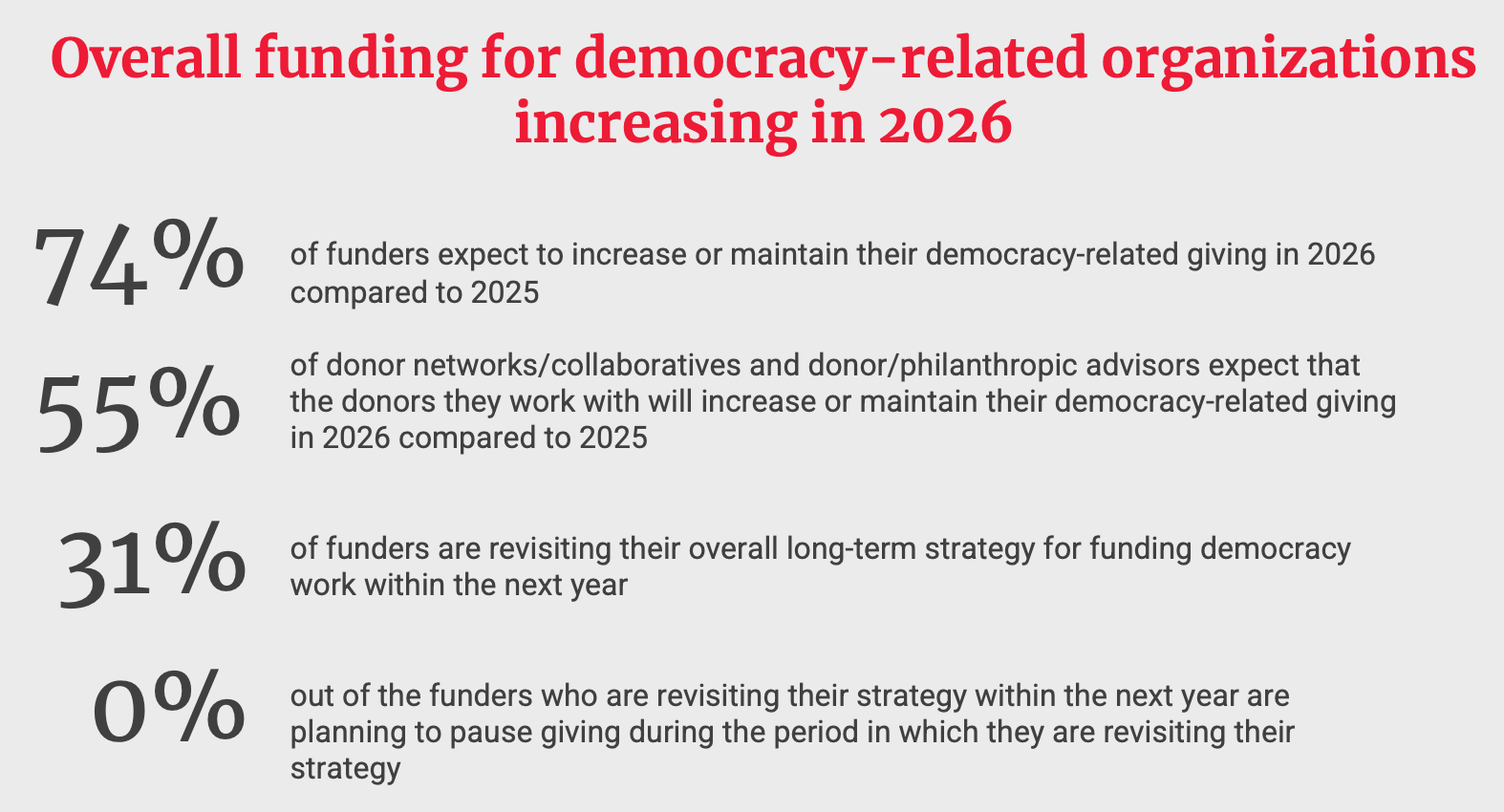
This is no doubt in part due to the upcoming midterms, but February’s survey showed the same thing.
Federal rancor, local cooperation
According to a May 2025 report by Civic Pulse, 83% of local leaders say polarization substantially harms the country, versus only 31% for their own communities.

Meanwhile, Congress is as polarized as it’s ever been, judging by their voting record. But at the local level, there’s a lot more bipartisan cooperation than you might expect.
Democratic Kentucky Governor Andy Beshear has been working wonders in a Red state. 50% of Kentucky Republicans approve of Beshear, the highest GOP approval for any Democratic governor, making him a serious contender for President in 2028.
In Minnesota they have no choice — the 67-67 tied House forced the creation of a formal power-sharing agreement with co-chaired committees requiring bipartisan votes to advance legislation.
And perhaps this spirit of cooperation is most striking in Colorado. Despite supermajorities of Democrats in both the House and Senate, 52% of bills received majority Republican support, including housing construction reform that had failed for years, nuclear energy legislation (GOP-led), and a George Floyd-era police reform law (SB20-217).
Polarization as poetry
This year saw the publication of WE, a collection of poetry about polarization by April Ossman. Here she is recounting a moment of fraternizing with the enemy at an airport.
Dear Atilla
Hello, fellow snowbird
with your second home in Florida,
in the city next to my in-laws-to-be.
Thank you for the pre-flight commiseration
over northern winters,
the mutual appreciation of a southern break,
for shared love
of certain books and movies
Thank you for favoring me with your dimples
and good cheer,
for your reluctance to hurt, with political dueling,
what you assume must be my liberal feelings
as a Vermonter
Thank you for dipping your toes in anyway,
for laving them in perfectly civil debate,
scaling walls,
for the concession that both sides
have been known to lie,
for your self-deprecating humor
in referring to yourself as being
to the right of Attila the Hun
But disarming and attempting to conquer
with charm instead of your namesake’s force,
for being so courteous
as to renew my faith
in the humanity of those
with whom I disagree politically
Game of the Week
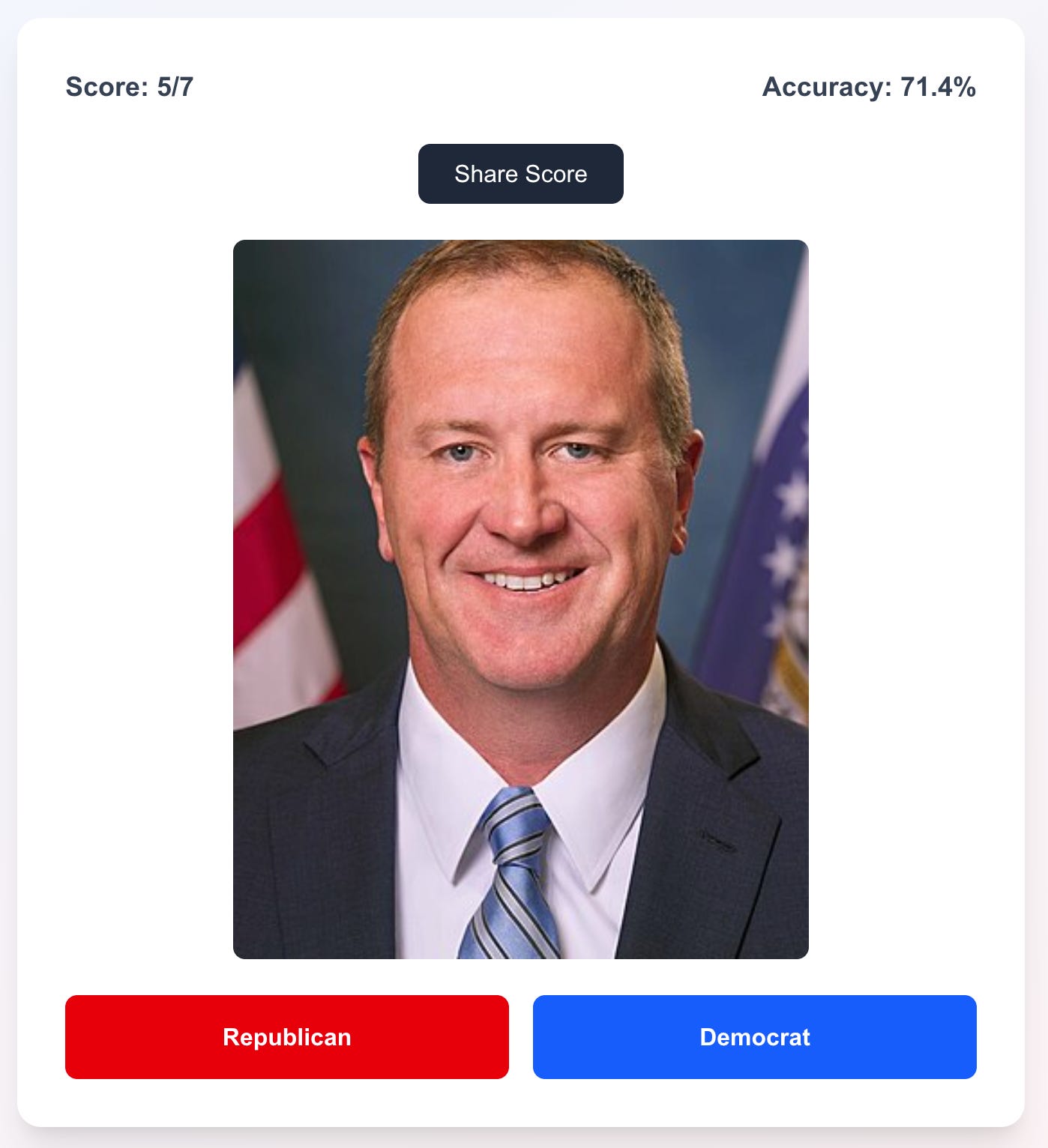
Senatordle - can you tell if a Senator is a Republican or a Democrat just by looking at their portrait?
Happy Holidays, everyone.
Thanks for the positive message! As a former state legislator, I was curious about the statistic from Colorado, because roll call votes are usually not a random sampling of votes, but a cherry picked set generally selected to highlight differences. It was interesting that Colorado seems to have voting records on all bills, so no voice votes, and therefore it's a solid statistic. But more interesting was that the story's headline was lamenting the drop in bipartisanship from the high of >95% before the pandemic... the percentage of votes (on bills that became law) that were NOT bipartisan has actually more than doubled in recent years. Just means we have even more opportunities for cooperation in 2026!
One of my experiments in bridge building is that I joined our local chapters of Rotary and Lion's Club. I am seeing that these local organizations, that already have chapters all over the world, can be forces for action and social connection. A few examples from my local groups:
Working with the local Community Resource Center. We are creating an 8 session cooking class for Elementary and Middle School students that culminates with them cooking a meal for their parents. And, to raise money for the project, we are throwing a Salsa and Swing dance party. https://events.humanitix.com/crc-salsa-and-swing-fundraiser
We do library readings of old radio shows, inviting the community to both participate and listen.
We have created quite a few awards programs for elementary, middle school, and high school students that have the students focus on local issues and local solutions. Here is an interview with one of the high school kids: https://youtu.be/lOBTL0qIMLg
Maybe we can encourage more people to seek out these clubs. They are fun, they build community, and they initiate social action.