

There is, in a sense, nothing more to say about this latest attempt on Trump. We wrote about political violence in America after Trump was shot, saying that no matter your politics, it would have been worse if he had been killed. We wrote about it again after Charlie Kirk was killed, collecting data to show that only a tiny minority actually approve of political murder.
Yet misperceptions persist, and the best takes I’ve seen so far are those that seek to correct them. Counting left vs. right attacks misses a general loss of trust in the political system. Attackers tend to be more educated not because we’re teaching people violence, but because the more educated are also more politically involved. And the many who called the shooting a hoax — despite hundreds of journalists in the room — underscore the need for trusted media.
Look to the system
Rachel Kleinfeld’s post is the single most useful piece I’ve seen on the shooting, not just because she’s a global expert on political violence, but because it refuses the bait of quantifying which side is worse. Instead it’s an overview of the state of American political violence in 2026.
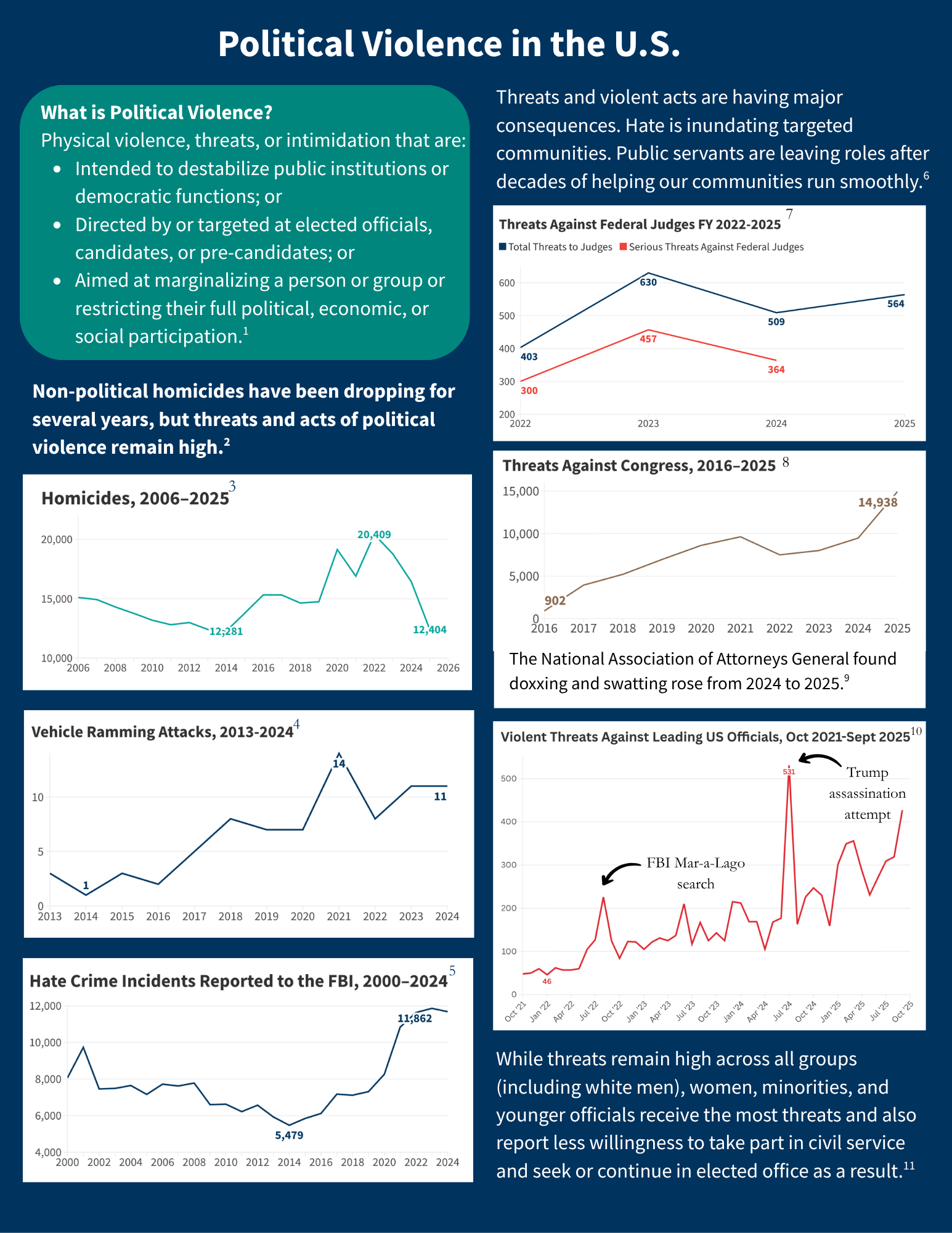
There was violence from the reactionary right in the 1950s, then from the radical left in the 1960s and 1970s, then from far-right militias in 1990s-2000s, and recently we’re seeing more on the left again. Over the decades the atrocity leaderboard has swung back and forth between political poles, but
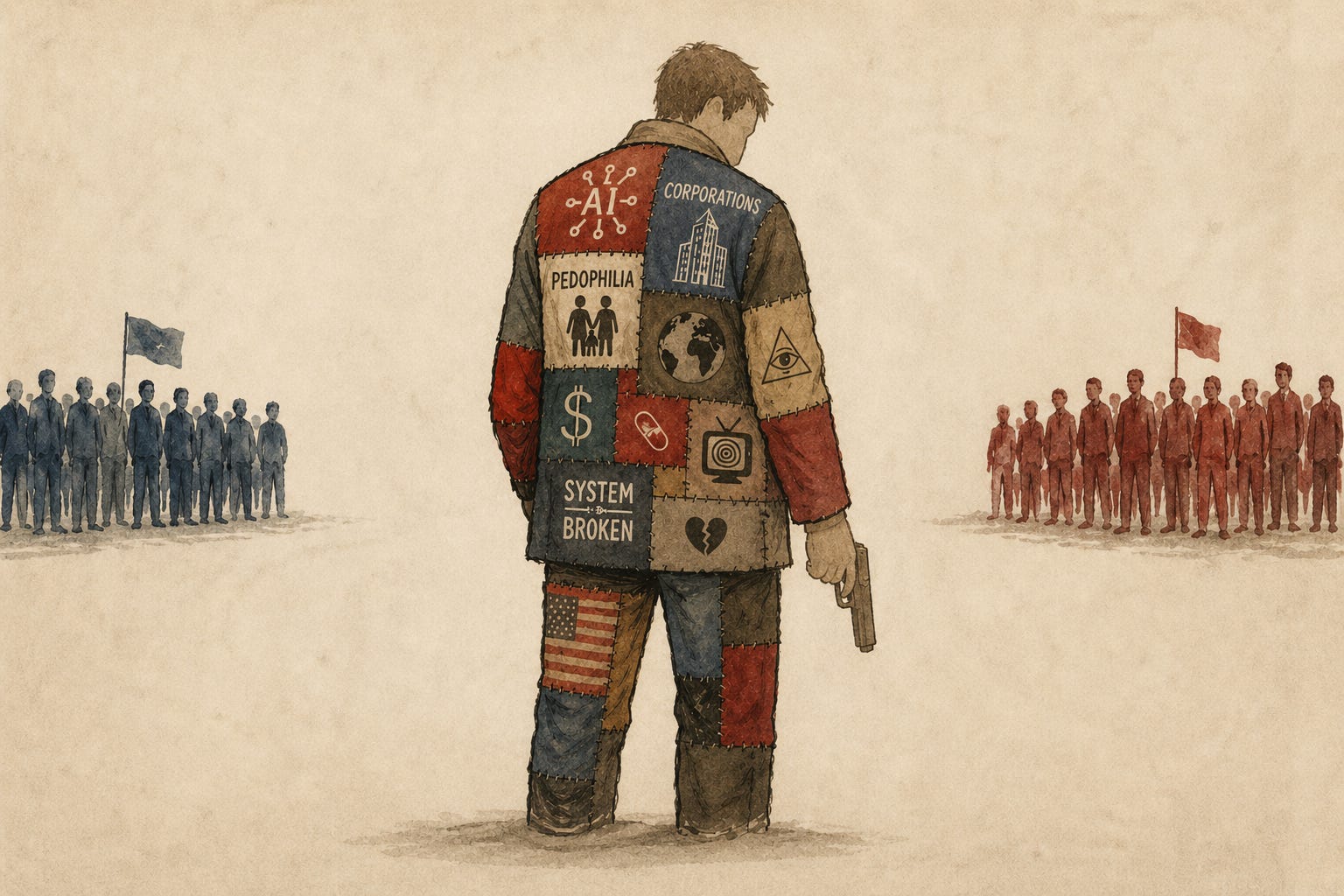
the best way to understand what is happening today is that left/right ideology is breaking down. Instead, most people who commit political violence now are facing mental health challenges, and are drawing from a mix of ideologies and positions – remember that the first Trump would-be assassin was also interested in shooting then-President Biden. Increasingly, political violence is committed by people who are angry about AI, corporations, pedophilia, and other issues that do not break down along a left/right spectrum.
…
Today’s assassins often have less in common with the left-wing Weathermen of the 1960s or the right-wing militia movement of the 1980s and 1990s, and more in common with school shooters who are driven by a sense of nihilism and hopelessness.
The Americans most supportive of political violence are no longer just “young,” they’re young and politically engaged, “those who are angry about our politics, but do not see a path to resolve issues through normal means.”
Young, educated, and angry
As always after an atrocity, there was a statistics fight over who was responsible. Last October, Rob Henderson posted a now-viral claim:
Relative to Americans with a high school education, Americans with graduate degrees are twice as likely to support political violence. More education = higher support for political violence. It couldn’t be otherwise.
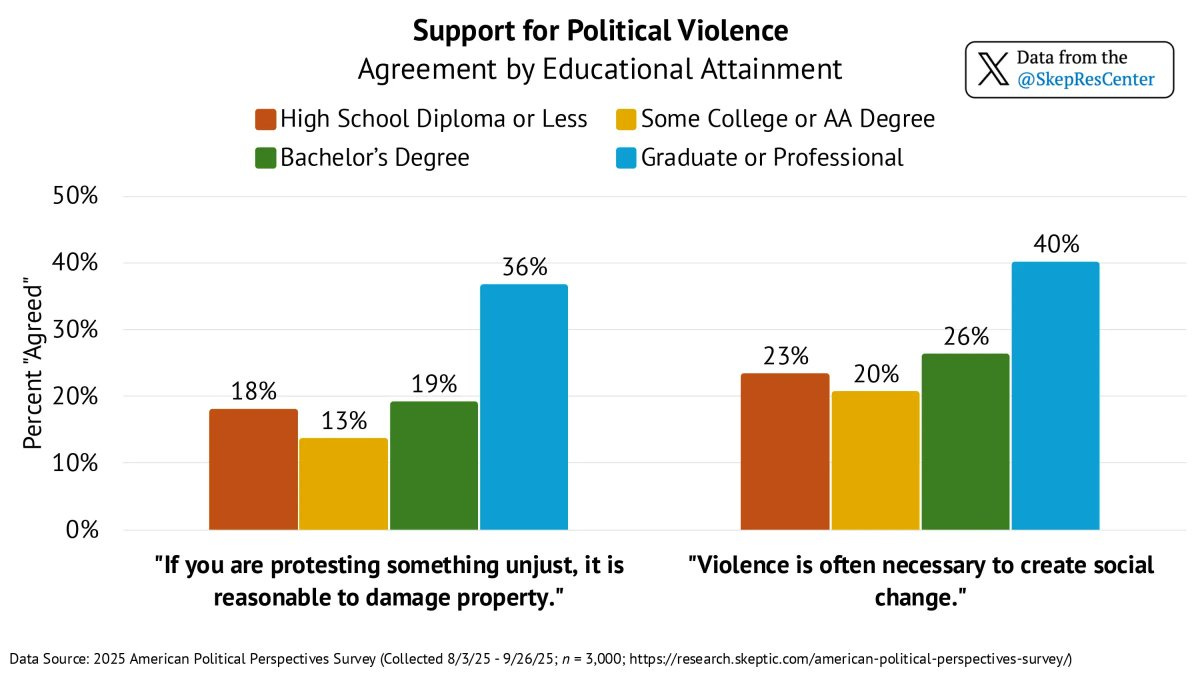
Alas, here’s where Elon Musk comes in. On Saturday he reposted this chart with the tag “Grad school indoctrination camps.” Indeed, it is true that education correlates with support for political violence. Just not for the reasons that Musk thinks and not nearly at these percentages.
We have repeatedly noted that support for political violence is a lot lower than simple surveys suggest it is, for a variety of methodological reasons. Sean Westwood, who runs the Polarization Research Lab, has made much more careful measurements, and brought out his own data in reply:
The rank order replicates with better data, but the % supporting partisan murder is much lower. Importantly, this is passive support and not willingness to actually murder.
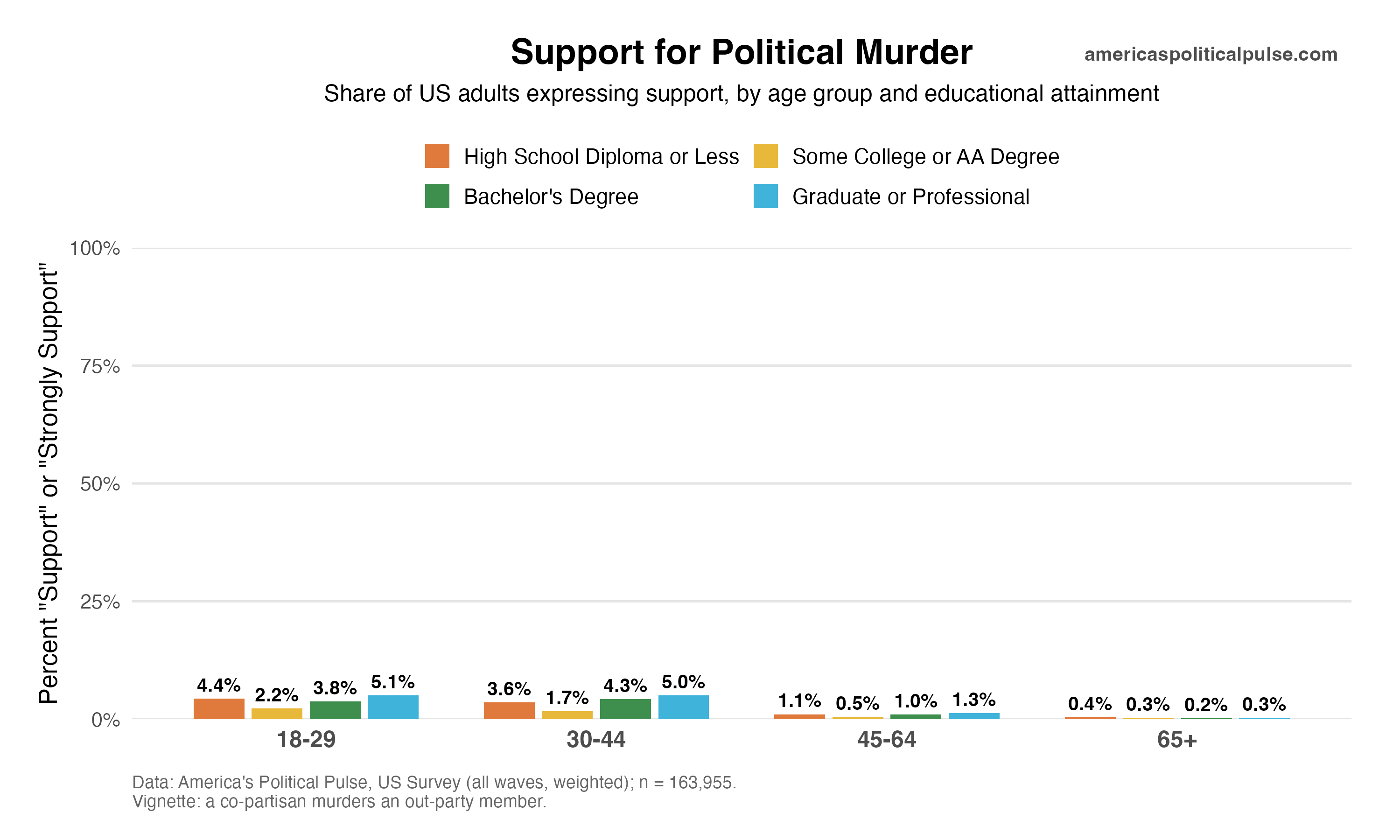
The most important thing Westwood is doing here is deflating the numbers. But he’s also acknowledging that yes, there is more support for political murder among more educated people. The correlation is real. Contra Musk, I don’t think grad school “indoctrinates” killers. For one thing, psychological traits are much stronger predictors of support for partisan violence than ideological extremity. However, it is definitely true that more educated people are more politically involved generally.
Also, Westwood is pointing out that both sets of numbers define “support for political violence” as passive ideological agreement. The gap between “violence might be justified in some cases” and “I will personally pick up a weapon” is enormous, and conflating them is itself highly polarizing. The number of potential killers out there is way, way smaller than Westwood’s maximum of 5.1%.
Alas, Westwood’s correction reached far fewer people than Musk’s repost. For that matter, the actual perpetrators of attacks on Trump and Kirk don’t fit the educated-leftist profile. Only Allen, the current suspect, has even a Bachelor’s degree.
The conspiracy is now the story
Tangle’s coverage, as usual, curates coverage from Blue and Red, but it’s the “my take” section which is most interesting this time. Unfortunately, one of the more common reactions (mostly, but not entirely, from the Blue side) was that the shooting was a hoax. By midday Sunday, there were more than 300,000 X posts using the word “staged.” It certainly didn’t help that the Trump administration immediately used the shooting to argue for the the construction of the beleaguered White House ballroom.

Even sitting politicians got in on it, with Rep. Jasmine Crockett (D-TX) publicly musing “Maybe it’s fake… who knows.”
This isn’t good. Tangle editor Isaac Saul writes:
Who knows.
Well, for one, the room full of journalists who heard the gunshots and saw the shooter apprehended on the ground are incentivized to find and share the truth. If you don’t believe their reporting, you can always watch the security camera footage of the shooter running through a group of very clearly unsuspecting federal agents yourself. Or you can read characterizations about the shooter from people who went to school with him.
…
There’s a difference between thinking The New York Times has a left-leaning bias and thinking reporters at The New York Times are so bad at their jobs they can’t accurately report on an event they were all in the room for.
His point is that, yes, of course the shooting was horrific, but the collapse of trust in the media, even for an event that took place in a room full of journalists, is itself a big problem.
Quote of the Week
The best indication so far the WHCD Trump shooting wasn't staged?
No evidence yet of huge insider bets just before it happened on Polymarket or Kalshi :-)
-Maarten Schenk (see also this context)
This is very interesting. I had no idea that there was a correlation between education and tendency to commit political violence. But in hindsight it makes total sense. Just seems like uneducated trump voters find just as many things to be mad about than those that attain higher education.
Thanks for this great post. I particularly appreciate citing Sean Westwood's research showing that many estimates of support for political violence are too high.
I had never seen the breakdown of the data from Westwood / Polarization Research Lab by age and education level. It's interesting it's bimodal, with highest support at the lowest and highest levels of formal education.
I'm interested if this pattern holds with other questions of political violence the Lab asks about, like vandalism or assault. With over 150,000 respondents, it should also be possible to break down the data by political affiliation and gender, which may generate additional insights.